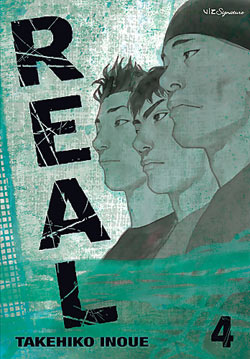
Slam Dunk may have been the series that put Takehiko Inoue on the map and introduced legions of Japanese kids to basketball, but for me, a long-time hoops fan who grew up watching Larry Bird lead the Celtics to numerous NBA champtionships, Slam Dunk was a disappointment, a shonen sports comedy whose goofy hero desperately needed a summer at Robert Parrish Basketball Camp for schooling in the basics. Real, on the other hand, offered this armchair point guard something new: a window into the fiercely competitive world of wheelchair basketball. Watching Inoue’s characters run a man-to-man defense and shoot three-pointers from their chairs gave me a fresh appreciation for just how much strength, stamina, and smarts it takes to play the game, with or without the use of ones’ legs.
Much of the series’ appeal lies with Inoue’s superb draftsmanship. As he does in both Slam Dunk and Vagabond, he immerses us in the action, making us feel as if we’re on the court with his characters, bumping rims and talking trash. No detail is squandered; even a close-up of a character’s eyes or hands helps us picture where his teammates are on the court, and imagine how the play might unfold.
The other thing that Real does incredibly well is give us a window into its characters’ emotional lives, something that the antic, frantic Slam Dunk never pauses to do. (In Inoue’s defense, I don’t expect a shonen comedy to shed much light on its hero’s interior life, especially one as dense and single-minded as the flame-haired Hanamichi Sakuragi.) Its three principle characters—Togawa Kiyoharu, a track-and-field standout whose promising career was snuffed by bone cancer, Nomiya Tomomi, a high school dropout responsible for paralyzing a girl in a motorcycle accident, and Takahashi Hisanobu, a high school basketball star sidelined by a spinal cord injury—are complex individuals whose foul tempers and bouts of self-loathing make them seem like ordinary people coping with extraordinary circumstances, rather than cardboard saints.
Consider Takahashi. Until the day he was hit by a truck, Takahashi embodied the big-man-on-campus stereotype, leading the basketball team, dating several girls at once, acing his exams, and enforcing the school’s social pecking order by ruthlessly hazing weaker students. The accident robs him not only of his mobility, but also his identity; Takahashi predicated his entire sense of self on what others thought of him. Once confined to a bed, however, he lashes out at anyone who shows him kindness: how dare these C- and D-list folk offer him pity? (In one of the series’ only running jokes, Takahashi evaluates everyone on a five-point scale, including the tough, homely nurse assigned to his ward. She rises in his estimation after ticking off a long list of American boyfriends.) As he begins the grueling process of rehabilitation, Takahashi’s sense of self is further undermined by the realization that learning to move again will require discipline, something he lacks. (In fact, Takahashi held his more disciplined teammates in contempt, viewing their work ethic as a sign of weakness.) His fear and anger begin curdling into self-pity, leaving him physically and emotionally paralyzed.
Degraded as the character may seem, however, Inoue never invites us to pity Takahashi. We feel his sense of loss and futility, yet it’s clear from Takahashi’s repellent behavior that he still has a strong will to live, giving us hope that his journey will end in redemption. What isn’t so obvious is how Takahashi will get his groove back, as Inoue doesn’t draw neat draw parallels between his story and Kiyoharu’s. (Nomiya, the dropout, emerged from his accident unscathed, and faces a somewhat different battle than the wheelchair-bound Takahashi and Kiyoharu.) Though it’s frustrating to wait and see what will happen to Takahashi, the slow and almost haphazard way in which his story unfolds gives the narrative a true-to-life rhythm that mitigates against a pat, uplifting resolution to the drama.
Inoue may take his time developing each character’s backstory, but he’s surprisingly efficient at establishing their personalities in just a few panels. The opening two pages of volume one, for example, speak volumes about Kiyoharu:
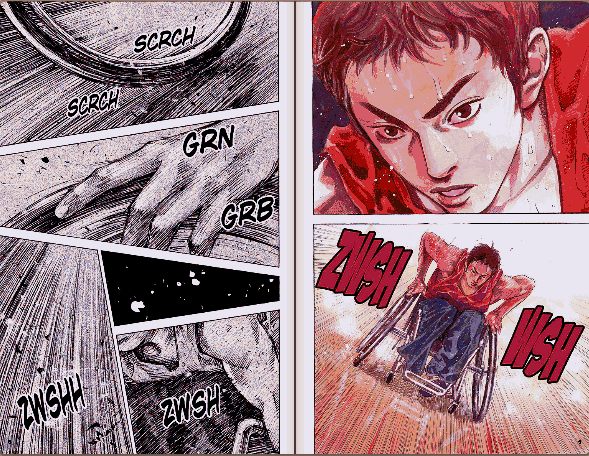
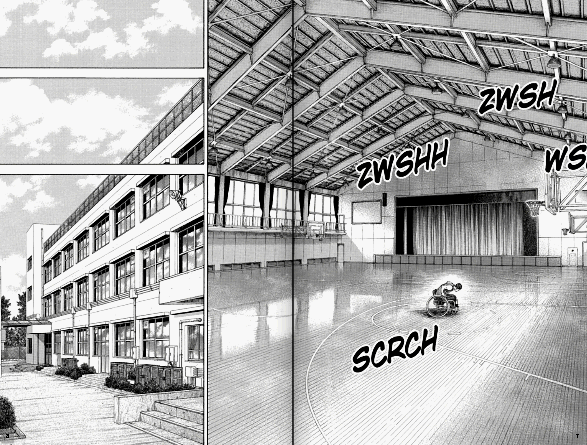
Through a combination of facial gestures and body language, those first five panels capture Kiyoharu’s fierce determination and incredible physical strength — he’s a consummate athlete pushing his body to its limits. Inoue then pulls back from Kiyoharu’s hands and face to reveal a lone figure dwarfed by an empty gymnasium. Kiyoharu’s discipline may make him a first-class basketball player, but as this image suggests, that discipline isolates him from other people — a theme that Inoue develops in volumes three and four, when Kiyoharu estranges his teammates with a grueling practice schedule and tough talk about winning.
Viz has done a terrific job of packaging Real, wrapping each issue in a beautifully designed cover and printing the artwork on creamy, high-quality paper that makes both the grayscale and full-color images pop. (I’m not really sold on the French flaps’ utility, though they certainly look cool.) John Werry’s fluid translation gives a distinct voice to each of the three principles — no mean feat, given how belligerent all three of them can be. Each volume includes a helpful set of cultural notes, as well as sidebars explaining the rules of wheelchair basketball; if anything, the American edition might have benefited from a more extensive appendix at the end of each volume.
I’m hoping that the deluxe presentation will encourage folks to give Real a try, regardless of their interest in basketball. It’s a sports story for those of us who care more about good writing and good artwork than the inner workings of a zone defense. But if you like to wax poetic about the Celtics/Lakers rivalry of yore, Real is your kind of series, too, as it will remind you just how beautiful the game can be when played with passion.
Review copies provided by VIZ Media, LLC.
REAL, VOLS. 1 – 4 • BY TAKEHIKO INOUE • VIZ • RATING: OLDER TEEN (16+)

John Jakala says:
I’m loving Real so far. Inoue does an incredible job putting everything together. There were so many things I loved about volume 3, like the sequence of Natsumi trying to get out of her chair on her own. Can’t wait til the price drops on vol. 4 so I can read it!
dsch1972 says:
I loved the sequence with Natsumi, too — I thought it did a beautiful job of showing just how grueling rehab can be. The review was bordering on a ridiculous length, though, so I cut my discussion of that (and several other) scenes. Guess that’s what a follow-up review is for!
Thanks for the feedback!