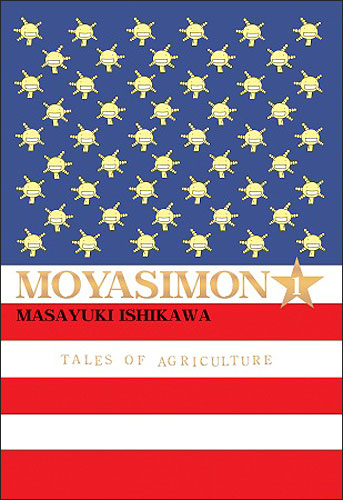
Warning: the Surgeon General has determined that reading Moyasimon: Tales of Agriculture may be hazardous to your health. Individuals who routinely consume large quantities of yogurt, miso, or natto; keep stashes of Purell in their purses and desk drawers; or have an irrational fear of germs or dirt are cautioned against reading Moyasimon. Side effects include disgust, nausea, and a strong desire to wash one’s hands repeatedly. Those with stronger constitutions, however, may find this odd little comedy fun, if a little too dependent on gross-out humor for laughs.
Moyasimon tells the story of Tadayasu, a country boy with an unusual gift: he can see and talk to bacteria. (In other words, he’s the Doctor Doolittle of the microbial world.) At the urging of his grandfather, Tadayasu leaves his small rural village to attend an agricultural college in Tokyo, his best friend Kei in tow. Tadayasu’s abilities bring him to the attention of the eccentric Professor Itsuki, a terraforming expert, and his foul-tempered research assistant Haruka Hasegawa, a graduate student who dresses like a dominatrix. Though they wax poetic about the scientific applications of Tadayasu’s gift, the pair seem more intent on making fermented delicacies — the smellier, the better — than actually conducting experiments. Also vying for Tadayasu’s attention are Misato and Kawahama, two sad-sack sophomores who reach out to him after bacteria compromise one of their numerous get-rich-quick schemes: bootleg sake.
Tadayasu, for his part, finds the attention unsettling. His dearest wish is to have a normal college experience, a desire frustrated by his family’s refusal to send him anywhere but an agricultural school. He also feels ambivalent about his gift. On the one hand, he understands its life-saving potential after thwarting an e-coli outbreak (he overhears the microorganisms rallying around the cry of “Brew ‘n’ kill!”); on the other hand, his microscopic “Spidey sense” makes many everyday activities — shaking hands, eating yogurt, visiting a messy dormitory room — agonizing, as he’s keenly aware of the bacteria’s presence. (In one of the story’s running gags, Tadayasu swoons whenever he visits Misato and Kawahama’s foul bachelor pad, a veritable bacteria playground of half-consumed beverages, dirty dishes, and fetid mattresses.)
 The humor is good-natured, though Masayuki Ishikawa indulges his inner ten-year-old’s penchant for gross-out jokes every chance he gets.He repeatedly subjects Tadayasu and Kei to Itsuki’s food fetishes, forcing them to watch Itsuki exhume and eat kiviak (a fermented seal whose belly has been stuffed with birds), or try a piece of hongohoe, a form of stingray sashimi so pungent it makes their eyes water. Ishikawa’s decision to render the bacteria as cute, roly-poly creatures with cheerful faces prevents the story from shading into horror, though it’s awfully hard to shake the image of bacteria frolicking in a bed of natto or around the slovenly Misato’s nostril.
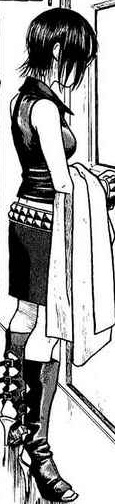
Where Moyasimon really shines is the artwork. Ishikawa’s layouts are detailed yet clear and easy to follow, giving the reader a strong sense of the college and its shabby environs. Ishikawa’s character designs are similarly effective, whether he’s drawing an L. yogurti bacterium or an unscrupulous professor. Take Misato and Kawahama. The two are a classic Mutt-and-Jeff duo: Misato is tall with a scruffy beard, a greasy ponytail, and weasel eyes, while Kawahama is short and round with a dirty face. When we first meet them, we immediately recognize them as a pair of sweating, scheming losers whose big dreams yield little returns. Hasegawa provides another instructive example of how design can play a critical role in establishing character. She’s prickly and aggressive, personality traits amplified by her unusual choice of labwear — knee-high boots with dozens of buckles and sky-high heels, studded belts, and a leather miniskirt — her sharp facial features, and her preferred accessory: a scowl.
Though the art is solid and the characters firmly established, Moyasimon hasn’t quite found its groove yet. Ishikawa can’t make up his mind if he wants us to admire the diversity and tenacity of bacterial life or squirm at the thought of its ubiquity; every educational speech about bacteria’s numerous benefits is punctuated by an icky rim shot. Still, it’s hard to deny the odd appeal of Moyasimon, as Ishikawa takes an all-too-familiar trope — the teen who sees things that other people can’t — and gives it a fresh, idiosyncratic spin.
MOYASIMON: TALES OF AGRICULTURE, VOL. 1 • BY MASAYUKI ISHIKAWA • DEL REY • 224 pp. • RATING: OLDER TEEN (16+)



jason says:
Why did Del Rey call it “Moyasimon” when the original was called “Moyashimon” (extra H) ?
Katherine Dacey says:
I wondered the same thing, Jason, as an internet search for Moyasimon yielded only references to the Del Rey edition.
James Moar says:
It’s because “shi” and “si” are both valid romanisations for the “し” in the original title — “shi” reflects the pronunciation, but “si” fits the layout of the Japanese syllabary better (and I’m with most gaijin and a reasonable number of Japanese in caring more about the former than the latter).
Katherine Dacey says:
Thanks for the explanation, James — that makes a lot of sense.
Sara K. says:
I remember in high school we looked at yogurt under a microscope, so I have literally seen little life forms wriggling around in that cultured dairy product. I don’t see what is so disgusting about the presence of bacteria in food (specific disease-causing bacteria yes, bacteria in general no), especially since some nutrients which are required for our own health are only produced by bacteria.
Katherine Dacey says:
I agree, Sara; the human body relies on millions of bacteria for its own health and functioning, and there’s nothing gross about that. I’m sorry if you came away from this review thinking my take on the book was, “Ew, bacteria!” It’s the personification of the bacteria in Moyasimon that makes them unsettling, not their mere presence, if that makes sense.
The most stomach-churning jokes, however, revolve around the fermented foods that Prof. Itsuki and his assistant make. Most of these are pretty extreme delicacies that the author has chosen for their shock value. If you know what lutefisk is, the author has combed Asia for its equivalencies.
Michelle Smith says:
Obviously I haven’t read this yet, but it still looks less gross to me than your average volume of Detroit Metal City. 🙂
Katherine Dacey says:
Wait ’til you read the chapter with the kiviak. Trust me when I say I found it much more unsettling than any of Krauser II’s bat-eating antics!
Laura says:
I got mixed feelings when reading this. The disgusting scenes that you describe above were easy enough to gloss over. There were some scenes that were intended to be gross comedy, that I didn’t find funny, such as sticking his hand up a cow’s anus. Yet, the scholar in me found the science interesting. Enough that the next day I was imagining what my workplace would look like if I could see germs. It would be much like the scene in the hospital I’m afraid. All in all though, I don’t know how long it could maintain my interest with the given characters and rancid comedy.
Katherine Dacey says:
That pretty much summarizes how I felt about it, too, Laura: some interesting science, a few OK gags, and a lot of unnecessarily gross jokes that weren’t all that funny. I think Johanna Draper Carlson summed it up better than I did when she described the hero’s gift as a “walking plot device”: it’s interesting, but one could substitute almost any number of other odd talents and end up with something similar.
You teach, don’t you? Man, I’d be terrified to see a classroom through Tadashi’s eyes — no doubt it would be a bacterial (and viral!) playground!